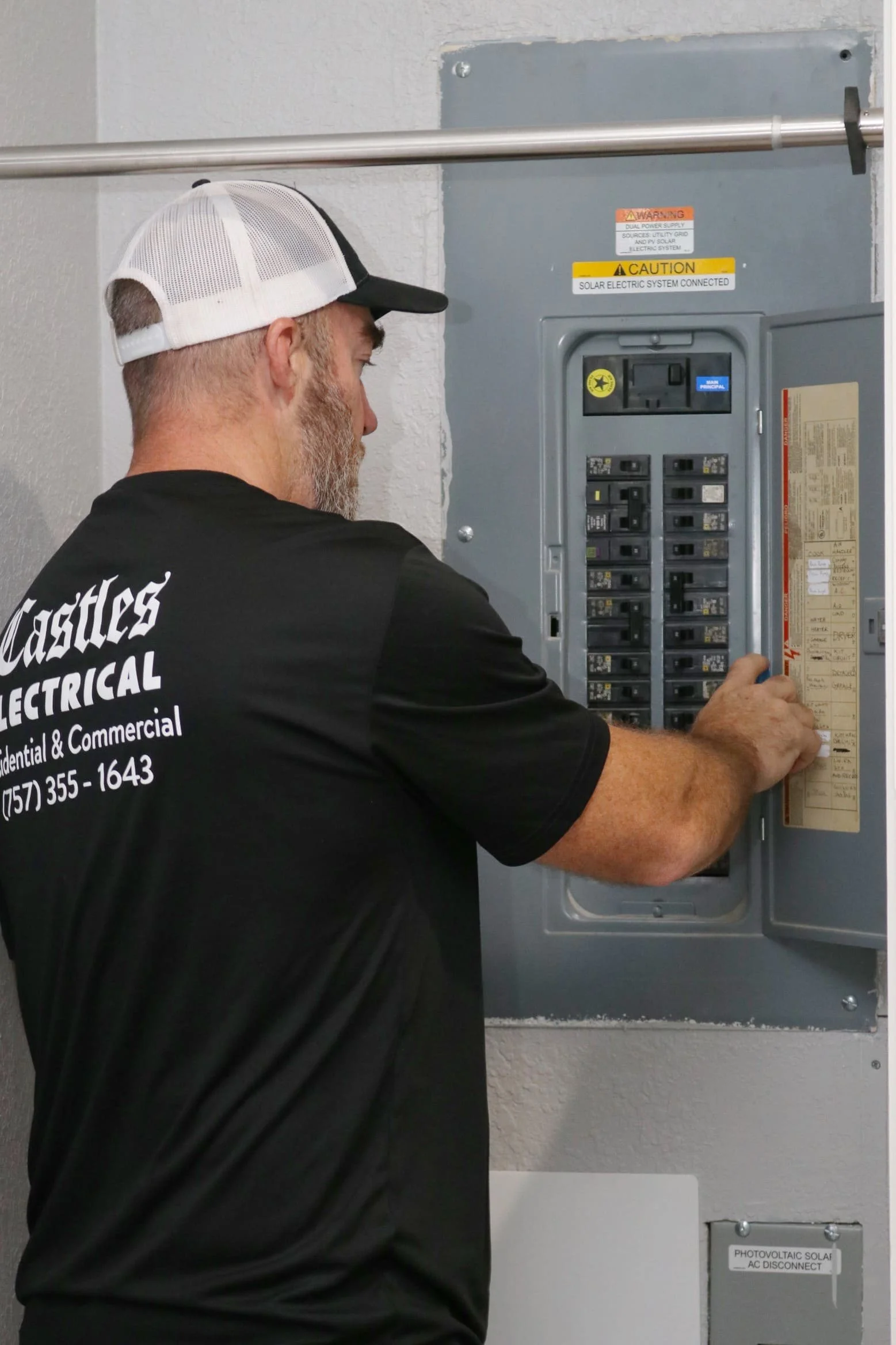
Electrical panel upgrade in Virginia Beach by Castles Electrical

Fire-Hazard Panel Experts · Permitted & Inspected

Electrical Panel Upgrades & Replacement in Virginia Beach, VA

Your electrical panel is the heart of your home's electrical system, and across coastal Virginia a huge share of that panel stock is decades past its service life. Castles Electrical replaces and upgrades panels across Virginia Beach, Chesapeake, Norfolk, Portsmouth, and Suffolk, from an insurance-flagged Federal Pacific box to a 100-to-200-amp upgrade for a new heat pump, hot tub, or EV charger. We are a licensed electrical contractor, and every panel we quote is installed by our own certified electricians.

Licensed. Insured. Trusted.  We treat your home like it's our own.
Whole-Home Surge Included Serving Virginia Beach & Nearby Cities
Electrical Panel Upgrades project photo

A panel upgrade is not a job to hand to the lowest bidder. We pull the permit, coordinate the utility disconnect and reconnect where the job calls for it, size the service correctly with a real load calculation, install whole-home surge protection as the code now requires, and label every circuit before we leave. Customers tell us the same thing they tell Google: clean work, an honest recommendation on whether you even need a full replacement, and a written price that does not change at the end.

Whether your breakers keep tripping, your insurer sent a renewal notice about your panel, or you are adding a load that the old service cannot carry, one call gets you a licensed electrician who will size it right, pull the permit, and tell you honestly what your panel needs.

GENERAC
TESLA
KOHLER
NABCEP
BBBA+
SquareD
GENERAC
TESLA
KOHLER
NABCEP
BBBA+
SquareD
Home / Services / Electrical Panel Upgrades

01 — Why Castles Electrical for Panel Work

Why Homeowners Choose Castles Electrical for Panel Work

01

Licensed & Insured

Master Electrician and Class B Contractor licensed, fully bonded, and insured for residential and commercial panel work.

02

Fire-Hazard Panel Experts

Federal Pacific, Zinsco, Pushmatic, and fuse-box replacements, the panels insurers now flag across our area.

03

Permitted & Inspected

We pull the permit, coordinate with the utility when the job requires it, and see the work through inspection every time.

04

Whole-Home Surge Included

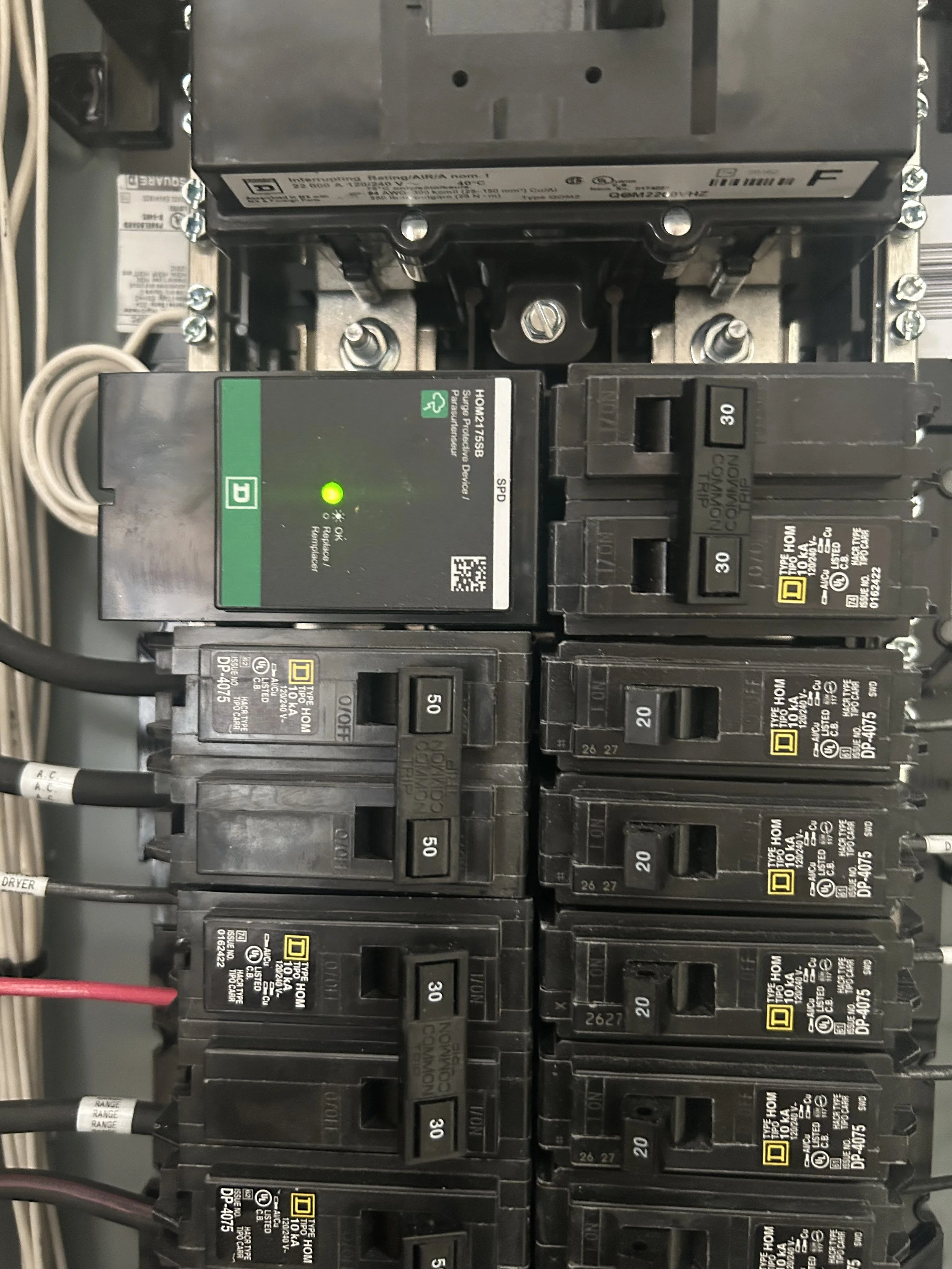
Every panel job includes a Type 2 surge protective device at the panel, as required by current code.

05

Real Load Calculation

We size according to an NEC Article 220 load calculation, not a rule of thumb, so your service fits your home.

06

Free Written Estimate

A firm written estimate, honored for 30 days, with no hidden fees.

02 — Three Reasons Homeowners Upgrade

Three Reasons Local Homeowners Replace a Panel

1

Your insurer flagged it, or it is a documented fire hazard

Federal Pacific Stab-Lok and Zinsco panels have a documented history of breakers that fail to trip, and insurance carriers across Virginia now increasingly require replacement at renewal. If you received a letter about the age or type of your panel, or your policy is at risk, that is the single most common reason our phone rings. We inspect the panel, tell you honestly whether it truly needs replacing, and handle the upgrade and the paperwork if it does. If it is safe, we say so.

2

Your panel cannot carry the load you are adding

A 100-amp service that was plenty in 1975 struggles under the modern stack of a heat pump, an electric water heater, an induction range, a hot tub, and an EV charger. When breakers trip under load, or there is simply no space left for a new circuit, an upgrade to 200 amps (or 320 amps for a solar, Powerwall, and EV stack) is what makes the rest of your project possible. We run a real load calculation, so the new service is sized to how you actually live.

3

Age, safety, and the coast

Panels 40 to 80 years old develop burnt bus bars, loose or corroded connections, double-tapped breakers, and missing grounding, and the salt air of coastal Virginia accelerates corrosion at the meter and the disconnect. A buzzing, warm, or scorched panel is not a nuisance to live with. It is a fire risk that a professional replacement resolves, along with the whole-home surge protection now required in our lightning-prone coastal climate.

03 — Common Panel Problems We Fix

Common Panel Problems We Fix in Virginia Beach, Chesapeake & Norfolk

Fire hazard and obsolete panels

These are the panels insurers flag and the ones we most often replace on safety grounds.

  • Federal Pacific Stab-Lok panel replacement (documented fire risk)
  • Zinsco and Sylvania-Zinsco panel replacement
  • Pushmatic and other obsolete breaker panels
  • Fuse-box to breaker-panel conversion
  • Recalled or discontinued panels with no available breakers

Capacity and space problems

When the service is maxed out or there is simply no room for another breaker, these fixes add capacity safely.

  • 100-amp to 200-amp service upgrades
  • 200-amp to 320-amp or 400-amp upgrades for solar, battery, and EV
  • No open breaker spaces for a new circuit
  • Breakers tripping under normal household load
  • Double-tapped breakers and improper tandem breakers
  • Subpanel installation for garages, workshops, additions, and pool equipment

Safety defects and code deficiencies

These are the defects that fail an inspection or a home sale, and the ones that quietly become fire risks if left alone.

  • Burnt, corroded, or overheated bus bars
  • Loose or backed-out neutral and ground connections
  • Missing or inadequate grounding and bonding
  • Grounds and neutrals sharing bars where they should be separated
  • Missing AFCI and GFCI breaker protection required by current code
  • Improperly backfed or oversized main breaker
  • Panel located in a closet, bathroom, or other non-compliant space

Coastal and storm-related issues

Salt air and storm surge create panel problems here that inland electricians rarely have to think about.

  • Salt-air corrosion at the meter base and exterior disconnect
  • Flood-vulnerable basement and crawlspace panels needing relocation
  • Water intrusion and rust damage inside the enclosure
  • Storm and lightning surge damage to the panel and breakers
  • Meter base and service-entrance cable replacement after storm damage
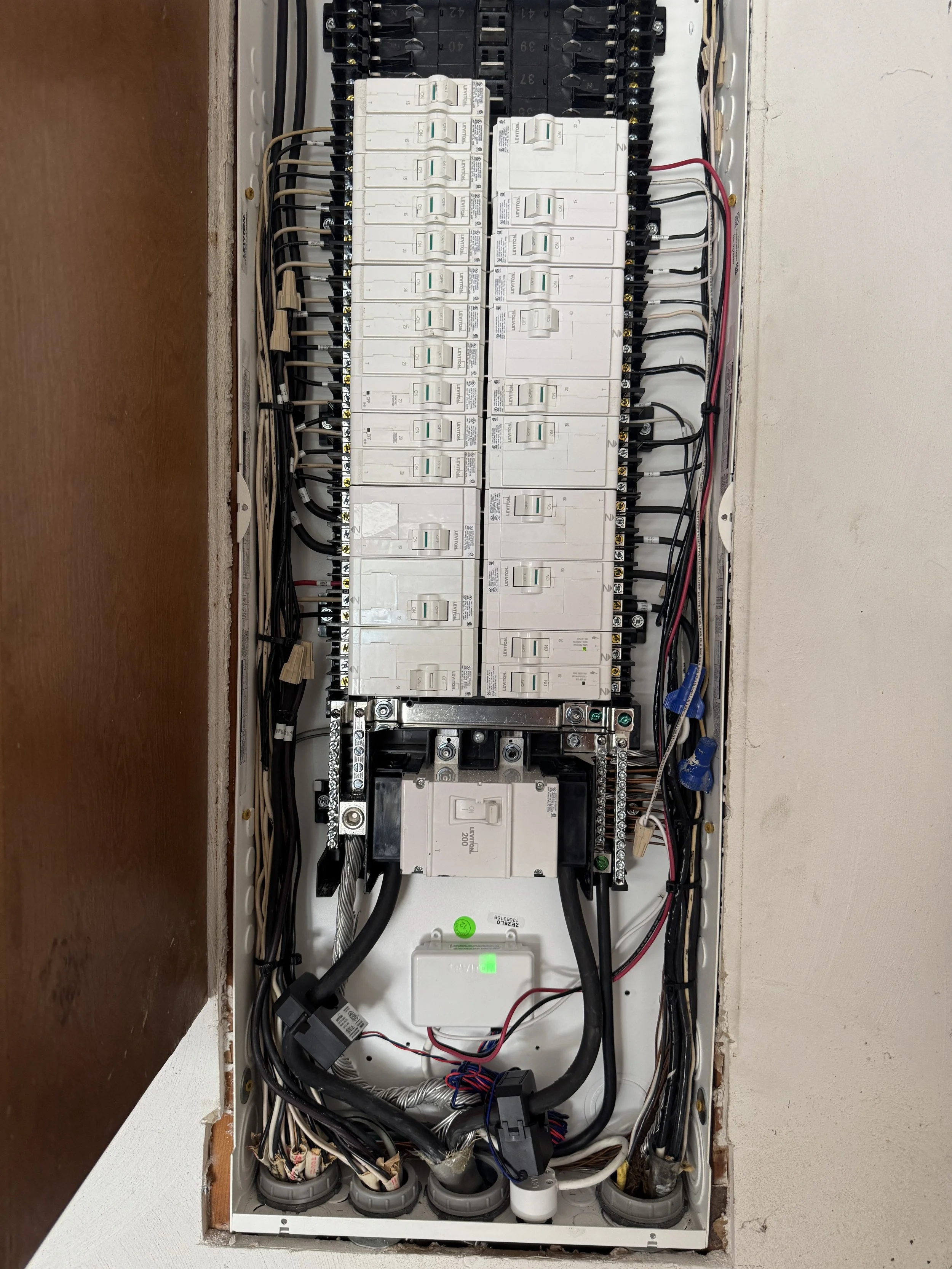
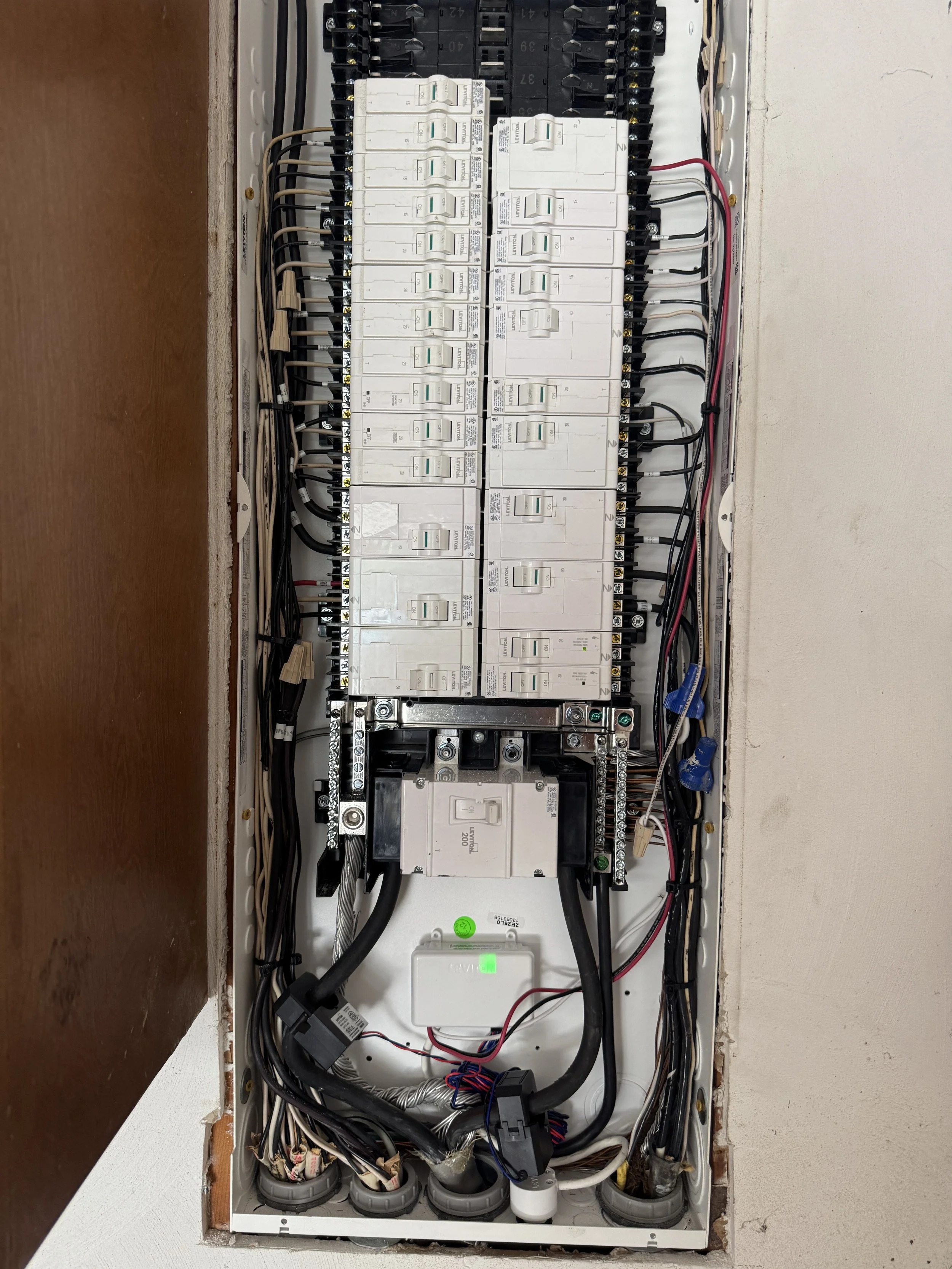
04 — Our Process, Start to Finish

How a Castles Electrical Panel Upgrade Works, Start to Finish

1

You reach a real person

Call (757) 765-8222 and you'll speak with a real person, not a call center. We ask about your current service size, what is prompting the upgrade, and whether it is urgent, like a burning smell or a dead panel, so we can prioritize appropriately.

2

Assessment and load calculation

For some panels we can give you an estimate from clear photos you send us, of the panel interior, the meter, and the label. When the job needs a closer look, one of our licensed electricians comes out to inspect the panel, meter, and service entrance, and runs a load calculation based on your actual equipment. Either way, this is where we tell you honestly whether you need a full replacement, a service upgrade, or a smaller fix.

3

A firm written estimate

You get a written estimate with the scope spelled out, and the price we quote is the price you pay. Install estimates are free and honored for 30 days. There are no surprise charges added at the end.

4

Permit and utility coordination

We pull the electrical permit with your city. When the job involves the meter or the service entrance, we also coordinate the utility disconnect and reconnect for the cutover, not every panel replacement requires it, and we tell you up front whether yours does. We schedule the inspection around your availability so someone can provide access if needed.

5

Install day

Our licensed electricians perform the swap in-house. Power is off only for the working portion of the day. We set the new panel, separate grounds from neutrals correctly, install the whole-home surge device, land and torque every connection to spec, and label every circuit.

6

Inspection and walkthrough

We schedule the inspection and see the job through to sign-off, then walk you through the finished panel, the labeling, and the surge protection. We clean up completely before we leave.

7

Warranty

Our workmanship is warrantied in addition to the manufacturer's warranty on the panel and breakers we install.

Castles team with branded van

05 — What Drives Panel Pricing

What Drives the Cost of a Panel Upgrade

Every panel is different, so we give a firm written estimate after seeing yours rather than a guess over the phone. If you would rather pay over time, we offer financing through Wisetack on repairs and replacements; financing is subject to credit approval and terms may vary. That said, here is what moves the number up or down, so there are no surprises when we quote it.

The scope of the change

A straight panel swap on an existing 200-amp service costs less than a 100-to-200-amp upgrade, which in turn costs less than a 200-to-320-amp service upgrade for a solar, battery, and EV stack. The bigger the service and the more of the service entrance that has to change, the higher the cost.

The meter base and service entrance

If the meter base, riser, or service-entrance cable is corroded or undersized for the new service, replacing it increases the job's scope. Coastal salt-air corrosion makes this more common here than inland.

Utility coordination, permits, and code items

A utility disconnect and reconnect where the job requires one, the city permit, code-required AFCI and GFCI breaker coverage, grounding-electrode upgrades, and the whole-home surge device are all part of a compliant job. We include them so the work passes inspection and protects your home, and we itemize them so you can see where the cost goes. We do not publish a flat panel price because quoting a number without seeing your service would not be honest. What we promise is a firm, written estimate, free, that holds for 30 days.

06 — Real Virginia Beach Panel Stories

Real Panel Projects Across Our Service Area

Allen had an old Federal Pacific Electric panel, one of the documented fire-hazard brands, replaced with a modern panel. He expected it to take all day. Castles Electrical completed the swap in about four hours.

Real Customer Example | From a verified Google review (Allen H., June 2026)

Kim had a panel blowout, a stressful emergency. Castles Electrical responded immediately, showed up the same day, correctly diagnosed the issue, and repaired numerous burnt ground wires. Wayne also took the time to reorganize the panel wiring so it was clean and safe going forward, with honest pricing and no shortcuts.

Real Customer Example | From a verified Google review (Kim W., May 2026)

Emory's dryer kept tripping the breaker, and the panel was buzzing. Castles Electrical got him on the schedule the same day, diagnosed a loose wire connection at the breaker, and then went further, checking the whole panel and tightening several other loose connections instead of fixing just the one. The problem was completely resolved.

Real Customer Example | From a verified Google review (Emory, May 2026)

Castles Electrical vs. National Franchise Electricians

How a locally owned, owner-licensed shop approaches a panel upgrade compared with the chain model.
Feature
Castles Electrical
National Franchise Electricians
Diagnostic approach
Load calculation and honest replace-or-repair call
Often quote a full replacement by default
Sizing method
NEC Article 220 load calculation
Rule-of-thumb tonnage or panel size
Whole-home surge
Included on every panel job per code
Sold as an add-on or skipped
Permit and utility coordination
We pull the permit and coordinate the utility when required
Varies
Grounds and neutrals
Separated and landed to code in the new panel
Frequently left combined incorrectly
Labeling
Every circuit is labeled at handoff
Often unlabeled or partial
Coastal experience
Salt-air meter and disconnect corrosion handled
Limited coastal experience
Warranty
Workmanship plus manufacturer's warranty
Varies
Castles team with branded vans

Castles Electrical

Panels done right: permitted, load-calculated, and labeled before we leave.

07 — Virginia Beach Local Conditions

Virginia Beach Conditions That Affect Your Panel

Coastal Virginia puts specific stresses on an electrical service that inland electricians do not deal with every day. Here is what actually matters for panels here.

1960s to 1980s tract housing is a fire-hazard-panel cohort

A large share of Virginia Beach, Chesapeake, and Norfolk housing was built between the 1960s and the 1980s, and much of it still runs original Federal Pacific Stab-Lok, Zinsco, or early breaker panels that are now 40 to 60 years old and at the end of their service life. These are the highest-priority replacement candidates in the region, and we see them every week.

Insurance-driven replacement is the number-one trigger

Virginia insurance carriers increasingly require that Federal Pacific and Zinsco panels be replaced or certified at policy renewal due to their documented failure-to-trip history. Many of our panel calls start with a homeowner holding a renewal letter. We handle the replacement and give you the documentation your carrier needs.

The hurricane belt makes whole-home surge non-negotiable

Coastal Virginia sits in the Atlantic hurricane belt, and we average a heavy summer lightning-storm season on top of named storms since Isabel in 2003. Nearby lightning strikes send voltage transients through the service that fry panels, breakers, HVAC boards, and electronics. That is why we install a Type 2 surge protective device at the panel on every job, which the current code now requires anyway.

Salt air corrodes the meter base and disconnects

Coastal salt air attacks the meter socket, the exterior disconnect, and outdoor panel hardware faster than it would inland, especially on waterfront property from Bay Island to Sandbridge. During a panel upgrade, we inspect the meter base and service entrance for corrosion and use corrosion-resistant hardware where it belongs.

Tidal and flood-zone panels sometimes need to move up

Low-lying areas of Norfolk, Portsmouth, and the Lynnhaven and Linkhorn corridors see tidal and storm flooding, and a panel in a flood-prone basement or crawlspace is a hazard. Where it makes sense, we relocate the panel and meter to a higher, weather-tight location as part of the upgrade.

EV, heat pump, and Powerwall load is driving 200 and 320 amp upgrades

This area has high EV adoption and steady heat-pump and battery-backup demand, and stacking those loads on an older 100- or 150-amp service does not work. A growing share of our upgrades is sized to 200 or 320 amps specifically to support an EV charger, a Tesla Powerwall, and modern electric appliances together.

Permits and utility coordination vary by city

A full service upgrade means a utility disconnect and reconnect and a permit with the local building department, and the process differs across Virginia Beach, Chesapeake, Norfolk, Portsmouth, and Suffolk. Not every panel job needs the utility involved, we tell you which yours is, handle the coordination when it applies, and schedule the inspection around your day.
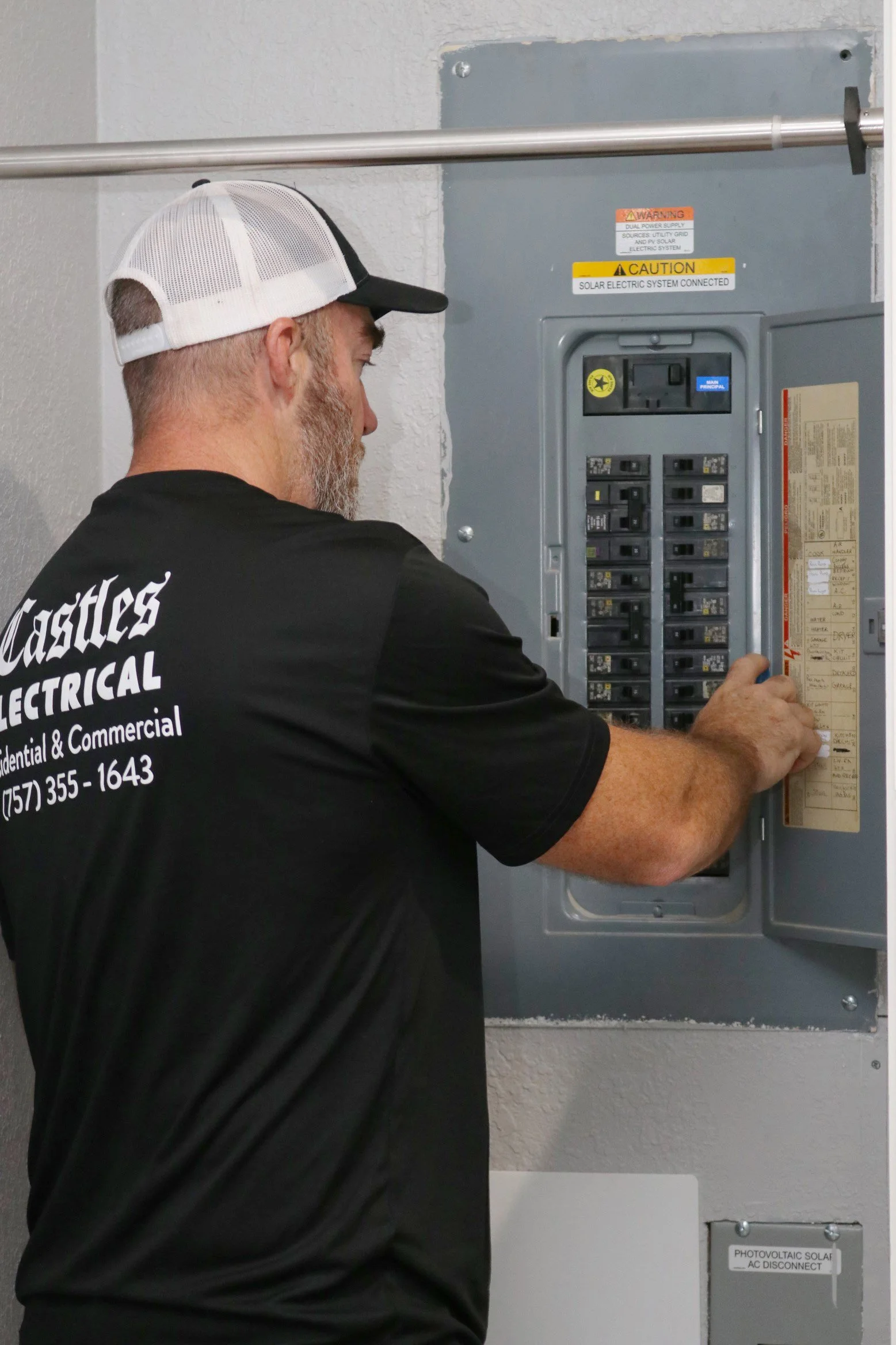
Panel work detail

08 — Expertise Deep-Dive

Expertise Deep-Dive: Panel Details That Separate Us

Most panel failures trace back to a handful of details that separate a professional installation from a rushed one. Here is what we actually do, and why it matters.

Load calculation to NEC Article 220, not a guess

Sizing a service by square footage or habit is how homes end up with a panel that trips or, worse, one that is oversized and wasteful. We run a real Article 220 load calculation that totals your general lighting, appliance, HVAC, and special loads, such as an EV charger, then size the service and the panel to that total. It is the difference between a service that fits how you live and one that either strains or costs you more than it should.

Separating grounds from neutrals in the new panel

In the main panel, grounds and neutrals bond together, but in every subpanel downstream, they must be separated onto isolated bars. Older and DIY panels frequently get this wrong, which defeats the safety path a ground is supposed to provide. On every panel we land, we set this correctly. We catch this constantly on older local panels where a previous owner or a rushed install combined them, and correcting it restores the safety path that a ground is supposed to provide.

Plug-on-neutral panels and full AFCI and GFCI coverage

Modern code requires arc-fault and ground-fault protection across most living-area and wet-area circuits. We spec plug-on-neutral panels that make that protection reliable and serviceable, and we install the AFCI and GFCI breakers your home actually requires rather than leaving gaps that fail inspection or leave you unprotected.

Meter base and service-entrance sizing for 200 and 320 amps

Upgrading the panel without upgrading the meter base and service-entrance conductors to match is a common shortcut that fails inspection. We verify that the meter socket, riser, and cable are rated for the new service and replace them where they are undersized or corroded, coordinating the conductor sizing with the utility where the service entrance is involved.

Grounding electrode system and bonding

A panel is only as safe as its grounding. We verify and, where needed, upgrade the grounding-electrode system, including driven ground rods, the water-pipe bond, and the gas and CSST bonding required by the current code. Inadequate grounding is one of the most common deficiencies we find in older homes here, and it is invisible until something goes wrong.

Whole-home Type 2 surge protection at the panel

A nearby lightning strike does not have to hit your house to damage it. A Type 2 surge protective device at the panel safely absorbs those voltage spikes before they reach your breakers, HVAC boards, appliances, and electronics. In a lightning-prone coastal metro, this is one of the highest-value few-hundred-dollar protections you can add, and code now requires it on panel work.

Torque to spec and label every circuit

Most panel fires start with a telltale buzzing at a loose connection that heats up over time. We torque every lug and breaker connection to the manufacturer's specification with a calibrated tool, not by feel, and we label every circuit so the next person, including you, knows exactly what each breaker controls. It is a small discipline that prevents the failure mode behind most of the emergency panel calls we get.

Castles electrician at work

09 — Panel FAQs

Panel Upgrade FAQs

How much does a panel upgrade cost?+

It depends on your current service, the condition of the meter and service entrance, and whether you are swapping a panel, moving from 100 to 200 amps, or upgrading to 320 amps. We give a firm written estimate after inspecting your panel, and the quoted price is what you pay.

How long does it take?+

Many residential panel replacements are completed in a single day. A recent Federal Pacific replacement took about four hours. Larger service upgrades that involve the meter base and utility coordination can take longer, and we tell you the expected timeline up front.

Will my power be off the whole time?+

Power is off only for the working portion of the cutover, not the entire visit. We plan the sequence to minimize downtime and let you know what to expect for the day.

Do you pull the permit?+

Yes. We pull the electrical permit, coordinate the utility disconnect and reconnect when the job requires one, and see the job through inspection. Permitted work protects you at resale and with your insurer.

Are Federal Pacific and Zinsco panels really that dangerous?+

They have a documented history of breakers that fail to trip during a fault, which is exactly when you need them to work. That is why insurers increasingly require replacement. We inspect yours and tell you honestly, but these two brands are high-priority replacement candidates.

Do I need 100, 200, or 320 amps?+

That comes down to your load. Most homes are well served by 200 amps. If you are adding solar, a battery, and EV charging together, 320 amps may be the right call. We run a load calculation so you don't have to guess.

Do I need a full upgrade or just a subpanel?+

Sometimes a subpanel adds the circuits you need without a full service upgrade, and sometimes the main service is the limiting factor and has to be upgraded. We assess your actual capacity and recommend the smallest change needed to solve the problem.

My insurance company flagged my panel. Can you help?+

Yes. This is one of the most common reasons homeowners call us. We replace the flagged panel and provide the documentation your carrier needs to keep your coverage.

Is whole-home surge protection included?+

Yes. We install a Type 2 surge protective device at the panel on every panel job, which the current code requires and which matters in a lightning-prone coastal metro.

Do you handle utility coordination?+

When a job involves the meter or service entrance, a utility disconnect and reconnect is required, and we handle that coordination and the scheduling so you do not have to. Many straight panel swaps do not need it, and we tell you up front which category yours falls into.

What is the difference between a panel upgrade and a service upgrade?+

A panel swap replaces the breaker box on your existing service; a service upgrade also replaces the meter base, service-entrance cable, and utility connection to carry more amperage. Some homes need only the panel, others the full service upgrade. We tell you which one your home actually needs.

How long do electrical panels last?+

Most panels last about 25 to 40 years, and coastal salt air tends to shorten that. Condition matters more than age, though: a panel with burnt bus bars, corrosion, or a discontinued breaker line is a replacement candidate no matter its age, while a sound modern panel can run for decades.

Can I replace my own panel?+

No. Panel work involves the utility service, high fault current, and code requirements, and in Virginia, it requires a permit and inspection coordinated with your city. We pull the permit, do the work to code, and see the inspection through so it is signed off and safe.

Can I add an EV charger or hot tub to my existing panel?+

Often yes, with load management, and sometimes only after an upgrade. We run a quick load calculation and tell you honestly which path your panel supports before you buy the equipment, so you are not stuck partway through a project.

Do you offer financing?+

Yes. We offer financing through Wisetack on general electrical repairs and replacements, so you can pay over time instead of all at once. Ask about it when you schedule. Financing subject to credit approval; terms may vary.

Google 5.0 Rated by Virginia Beach Homeowners

Castles Electrical maintains a 5.0 rating on Google. The reviews below load as a live widget, so this page always shows current, verified feedback from real customers across Virginia Beach, Chesapeake, Norfolk, and the surrounding communities.

Leave Us a Google Review

Ready When You Need Us

Ready to Upgrade Your Panel? Contact Castles Electrical Today.

Get a free written estimate from a licensed, local electrical contractor that pulls the permit, sizes the service correctly, and labels every circuit before leaving.

Hours

  • Monday to Friday: 7:00 AM to 10:00 PM
  • Saturday: 7:00 AM to 7:00 PM
  • Sunday: Closed
  • After-hours calls answered until about 10:00 PM; urgent issues get a fast response, others a next-morning callback

Service area

Virginia Beach, Chesapeake, Norfolk, Portsmouth, and Suffolk, including the Virginia Beach waterfront communities of Great Neck, Bay Colony, Cape Henry, Sandbridge, and Lago Mar.

Castles Electrical: licensed, locally owned, and doing panels right across our service area since 2012.

Castles Electrical electrician greeting a homeowner at the front door